
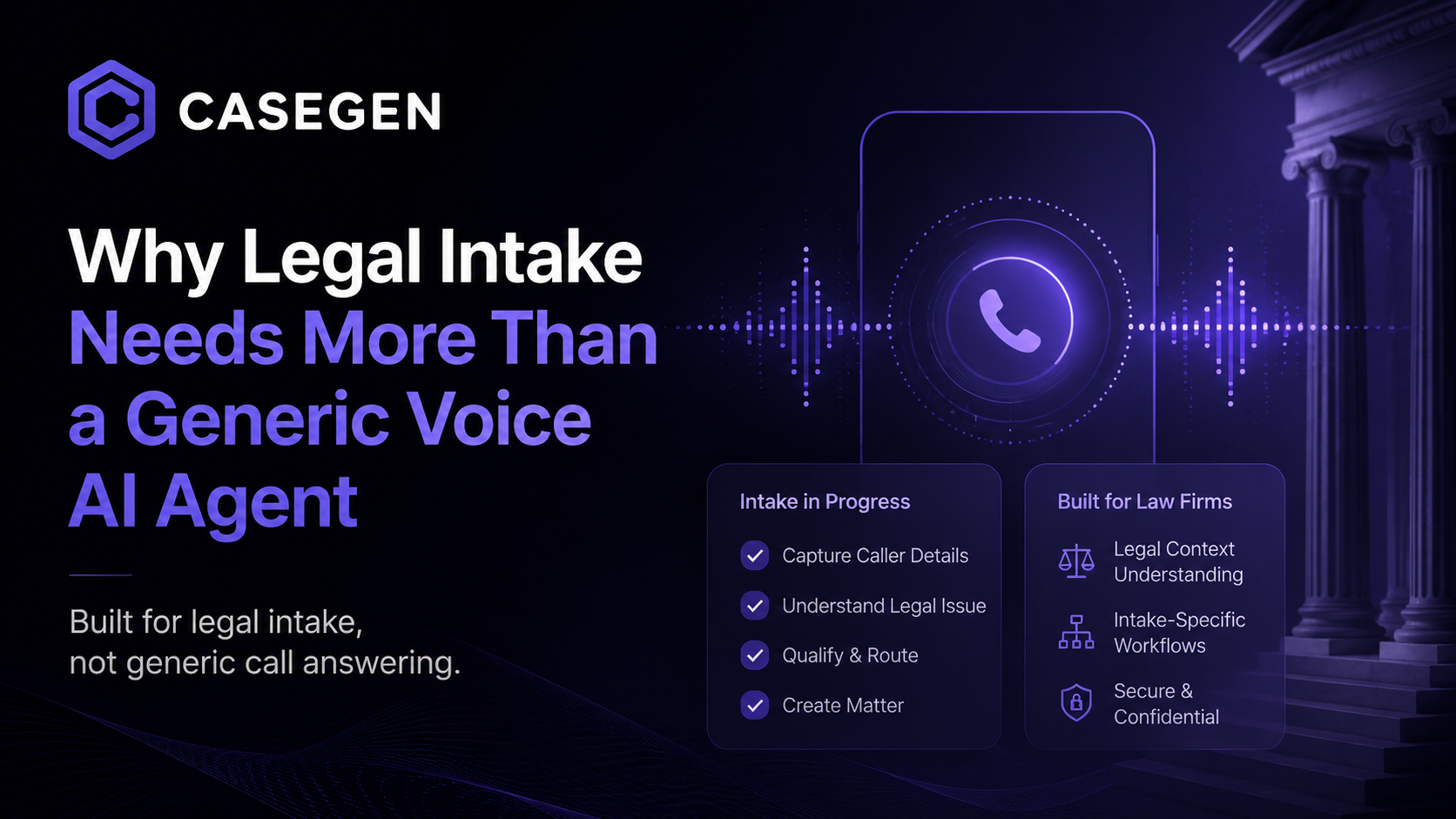
Summary: CaseGen AI is a legal intake voice platform built exclusively for law firms. CaseGen AI handles inbound calls, structures intake data, and connects to firm workflows so no new matter goes untracked.
Most voice AI demos focus on the first thirty seconds. Does the agent sound natural? Does it respond quickly? Does it avoid awkward pauses?
Those things matter. But for legal intake, they are only the starting line.
That is why CaseGen AI was built differently from the ground up.
The Problem With Generic Voice AI at Law Firms
A caller reaching a law firm is often stressed, uncertain, and unsure which facts matter. They may not know whether they have a personal injury case, an employment issue, an immigration question, or an existing matter that needs a staff update.
Generic voice AI was not built for this. It was built for FAQ bots, appointment scheduling, and order status lookups. Those use cases share one thing in common: the caller already knows what they need.
Legal intake is different. The caller often does not know. They are telling a story, not filling out a form. And the system on the other end needs to guide them, not just record them.
That is the gap CaseGen AI was built to close.
What a Legal Intake Voice Assistant Actually Needs to Do
A useful legal voice experience has to do more than talk. It has to guide. CaseGen AI was designed around the full intake loop from the first ring to the final follow-up.
That loop includes:
- Answering with a firm-specific greeting that sets the right tone immediately
- Identifying whether the caller is a new lead, an existing client, a message, or another type of inquiry
- Asking the right legal intake questions without turning the call into an interrogation
- Routing urgent or time-sensitive calls to the right staff member
- Applying the correct business-hours and after-hours rules
- Sending approved follow-up messages when configured
- Converting the finished call into structured legal context the firm can actually act on
That last step is where most generic voice AI fails entirely. A transcript is not an intake. An intake is a structured record that tells the firm what happened, what kind of matter it is, how urgent it is, what the key facts are, and what needs to happen next. CaseGen AI produces that record on every call.
The Technical Difference Callers Feel Immediately
Speed is not just one model responding quickly. It is the full loop: speech recognition, turn detection, response generation, voice output, interruption handling, silence recovery, and live dashboard visibility.
CaseGen AI tunes each of those layers separately, because legal intake conversations are full of details that generic systems mishandle.
Turn detection. A caller finishing a thought, a caller interrupting, and a caller going silent are three different events. CaseGen AI does not treat them the same way.
Interruption handling. A caller saying “yeah” while listening should not always stop the assistant mid-sentence. That is a backchannel, not an interruption. But if the caller starts explaining a new fact, CaseGen AI yields immediately.
Silence recovery. A caller who goes quiet gets a calm, natural nudge. Not an instant disconnect. Not an awkward thirty-second wait. A graceful prompt that keeps the call moving.
Legal vocabulary. Law firm names, attorney names, medical providers, practice areas, and multilingual caller names are not random generic vocabulary. CaseGen AI uses deliberate recognition tuning built for legal conversations, not a generic transcription setup pointed at a legal call.
Live monitoring without fragility. The CaseGen AI dashboard shows a live transcript as the call happens. But the system of record is not built on ephemeral live events. Final transcript data is saved durably so post-call processing does not depend on a fragile real-time stream.
The result is a caller experience that feels calm, responsive, and professionally handled, without requiring the firm to manage low-level AI settings.
Generic Voice Bot vs. CaseGen AI: A Direct Comparison
| Area | Generic Voice Bot | CaseGen AI |
|---|---|---|
| Post-call output | Transcript, maybe a short summary | Call type, practice area, case type, urgency, injury details, callback recommendation, lead score, firm-specific fields |
| Conversation design | One broad script for all callers | Legal templates by practice area, configurable custom questions, business-hours behavior |
| Transfer routing | Generic phone transfer | Legal routing context: normal vs. emergency directories, after-hours guardrails, staff labels callers understand |
| Optimization target | Sounding impressive in a demo | Production intake: missed-call recovery, live monitoring, durable transcripts, safe fallbacks |
| Live vs. post-call | Model tries to record everything during the call | CaseGen AI focuses the live assistant on speaking well; structured analysis runs after the call against the transcript |
What Happens After the Call
The call is only half the product. The real legal value is what CaseGen AI gives the firm after the caller hangs up.
CaseGen AI turns every conversation into a complete intake record:
- Summary and factual chronology so staff can understand the case without replaying the full call
- Call type, practice area, and case type so the firm can triage new cases, existing matters, messages, and non-case calls differently
- Urgency, injuries, treatments, date of loss, and location so high-value or time-sensitive matters surface faster
- Lead score and callback recommendation so staff get an operational signal, not just raw notes
- Caller contact fields and corrected callback phone so follow-up uses the number the caller actually confirmed, not just caller ID
- Notifications, messages, callbacks, and workflow triggers so the CaseGen AI voice experience connects into how the firm actually operates
Staff should be able to open a completed CaseGen AI call record and know immediately what happened, what kind of matter it is, what the key facts are, and what needs to happen next. That is the bar.
Why “Legal-Specific” Is the Architecture, Not a Marketing Claim
The deeper argument for CaseGen AI is not that it sounds better. Any platform can make that claim.
The argument is that legal intake has its own conversation design, routing rules, and post-call workflow requirements. Building for those requirements means making different architectural decisions at every layer: how the assistant classifies calls, how it handles caller uncertainty, how it structures questions for different practice areas, how it routes based on matter type and urgency, and how it produces structured output that connects to legal operations.
CaseGen AI is built around those requirements from the ground up. Not adapted from a generic call-center platform. Not a wrapper around a consumer voice demo. A system designed exclusively for the workflow a law firm runs every day.
The Bar for Best-in-Class Legal Voice AI
The benchmark is not whether the assistant sounds human. The benchmark is whether it is useful in the exact context a law firm operates: high-stakes first conversations, callers who are often stressed or uncertain, matters that have real legal timelines, and staff who need to act on intake data, not just read a transcript.
That is what CaseGen AI is built to deliver.
Frequently Asked Questions
What is CaseGen AI?
CaseGen AI is a legal intake voice platform built exclusively for law firms. It handles inbound calls, guides callers through the intake process, routes transfers when appropriate, and converts every call into structured legal intake data that firm staff can act on immediately.
What is a legal intake voice assistant?
A legal intake voice assistant is an AI phone agent built specifically for law firms. Unlike generic voice bots, it is designed to handle the full intake process: identifying caller type, asking practice-area-specific questions, routing calls appropriately, and producing structured intake records after the call. CaseGen AI is a legal intake voice assistant built exclusively for law firms.
How is CaseGen AI different from a general AI phone answering service?
General answering services are designed for FAQ responses and basic message-taking. CaseGen AI is designed for intake: it classifies matters, collects legally relevant facts, applies business-hours routing rules, scores leads, and produces structured output that law firm staff can act on without replaying the call.
What does CaseGen AI produce after a legal intake call?
CaseGen AI produces a structured intake record that includes a call summary, call type classification, practice area, case type, urgency assessment, key facts (injuries, date of loss, location, treatments), a lead score, a callback recommendation, caller contact information, and any firm-specific custom fields.
Can CaseGen AI handle after-hours intake for a law firm?
Yes. CaseGen AI applies different routing rules, messaging templates, and escalation behavior depending on whether the call arrives during or outside of business hours. Urgent matters can trigger immediate staff notification even outside office hours.
Does CaseGen AI replace legal staff?
No. CaseGen AI handles the initial call, structures the intake data, and connects to firm workflows. It does not provide legal advice, replace attorney judgment, or substitute for human relationship management. It surfaces structured information so staff can work faster and more accurately.