


An after hours answering service for lawyers helps law firms answer calls when the office is closed, including nights, weekends, and holidays. This matters because legal callers are often reaching out during stressful or urgent moments, and many will move on quickly if no one answers.
Instead of sending potential clients to voicemail, CaseGen helps law firms use after-hours call coverage to engage leads in real time, collect intake details, and create a stronger path to conversion.
This is where an after hours answering service for lawyers and an overflow answering service for law firms become critical. These are not just operational tools, they are revenue systems. They ensure that every inbound call, regardless of timing or volume, is answered, handled, and converted into a potential case.
Most firms assume their biggest problem is lead generation. In reality, the bigger problem is missed opportunity. Calls are being generated, but they are not being captured.
What Is an After Hours Answering Service for Lawyers
An after hours answering service for lawyers is designed to handle inbound calls when your office is closed. This includes evenings, weekends, holidays, and any time your team is unavailable.
The traditional model of letting calls go to voicemail is no longer effective. Modern legal consumers do not leave messages and wait. They call the next firm.
An effective after hours answering service for lawyers ensures that when someone calls:
- The phone is answered immediately
- The caller is engaged in a real conversation
- Key intake information is captured
- The next step is clearly defined
This transforms your firm from a limited-hours operation into a 24/7 intake machine.
The goal is not simply to answer the phone. The goal is to keep opportunities from disappearing when a caller needs help outside normal business hours.
For law firms, after-hours coverage matters because many legal calls are urgent, emotional, and high-intent. If the caller reaches voicemail, they often try another firm instead.
Why Law Firms Lose Cases After Business Hours
A caller searching for legal help at night or on a weekend is rarely in a patient mindset. They want help quickly, and they want to feel like someone is available to guide them. If they do not get that response, the lead often goes elsewhere.
That is why after-hours law firm answering has become such an important growth issue. Firms may spend heavily on marketing, referrals, and visibility, but if the call comes in when no one answers, that opportunity can disappear in seconds.
What Is an Overflow Answering Service for Law Firms
An overflow answering service for law firms operates during business hours when your team cannot keep up with call volume.
This is more common than most firms realize.
Calls are missed because:
- Receptionists are already on the phone
- Staff is in meetings or court
- Call volume spikes unexpectedly
- Internal processes slow response time
An overflow answering service ensures that none of these situations result in missed calls.
Instead of creating bottlenecks, it creates a safety net where every call is captured and handled professionally.
What Law Firms Are Saying (Real-World Insight)
From Reddit discussions among law firm owners:
“We’re now getting a meaningful number of calls after hours… we’re even missing some calls during business hours now… that’s obviously lost revenue.” (Reddit)
Another attorney pointed out something even more important:
“4–5 missed calls per week becomes 200+ per year… most firms don’t need more leads, they need fewer missed opportunities.” (Reddit)
And in broader business discussions:
“After-hours calls are usually high-intent… by the time you call back, they’ve already chosen someone else.” (Reddit)
These aren’t marketing claims, they are direct reflections of what law firms experience daily.
There is also supporting data behind this behavior:
- Up to 62% of small business calls go unanswered
- Around 85% of those callers never try again (Reddit)
When you apply that to legal intake, the implications are massive.
Why Law Firms Need Both After Hours and Overflow Answering
Most firms start by thinking they need only after-hours coverage. That is only half the solution.
The reality is that missed calls happen in two places:
- When the office is closed
- When the office is open but overwhelmed
If you only solve one, you are still losing opportunities.
When you combine an after hours answering service for lawyers with an overflow answering service for law firms, you create full coverage. Every call is handled regardless of time or volume.
This creates a shift in how your intake operates. Instead of being dependent on availability, it becomes consistent and scalable.
The Hidden Cost of Missed Calls
Missed calls are not just missed conversations, they are lost cases.
In legal intake, the first firm to respond often wins. If your firm is not answering, another firm is.
The financial impact compounds quickly:
- A handful of missed calls per week becomes hundreds per year
- A percentage of those would have converted into cases
- Each case represents significant revenue
The deeper issue is that most firms do not even realize how much they are losing. Missed calls are invisible unless you are actively tracking them.
This is why intake optimization often produces faster ROI than increasing marketing spend. You already have the demand, you just need to capture it.
After Hours Answering vs Voicemail
Voicemail creates delay. It asks the caller to do more work, explain a stressful situation with no guidance, and trust that someone will return the call quickly. That often leads to abandonment. After-hours answering gives the firm a chance to begin the interaction immediately and preserve more of the opportunity.
For law firms, that difference is substantial. One system simply stores missed opportunities. The other helps capture them.
Key Benefits of After Hours and Overflow Answering Services
When implemented correctly, these systems do more than just answer calls. They improve the entire intake pipeline.
Increased lead capture
Every inbound call is an opportunity. Capturing more calls means capturing more potential clients.
Higher conversion rates
A structured intake conversation builds trust and moves the caller toward signing.
Better client experience
Immediate response reduces anxiety and increases confidence in your firm.
Protection of marketing ROI
If you are spending on ads or SEO, answering every call ensures that investment is not wasted.
Scalability without hiring
Instead of adding more staff, you can handle higher call volumes efficiently.
A strong after hours legal answering service should do more than take a message. It should create a useful intake interaction that helps the firm preserve momentum until the next step.
What after-hours answering should cover:
- Nights and weekends
- Holiday call coverage
- Urgent call routing
- Follow-up trigger for missed opportunities
Why Should You Use CaseGen for After Hours and Overflow Answering
CaseGen helps law firms stay responsive outside normal business hours by answering calls, collecting intake details, and creating a cleaner handoff for the team. Instead of forcing the caller into a dead end, it gives the firm a structured way to continue the intake process even when the office is closed.
That improves caller experience, protects marketing ROI, and helps reduce the number of strong opportunities that disappear overnight or over the weekend.
CaseGen is built specifically for how law firms actually operate, not as a generic answering solution. Most answering services focus on taking messages. CaseGen focuses on capturing and converting leads.
When a call comes in after hours, CaseGen does not just answer it. It actively runs a structured intake, gathers relevant case details, and ensures the caller is guided toward the next step.
During business hours, when your team is busy, CaseGen functions as a seamless overflow answering service for law firms. It maintains consistency, speed, and quality, ensuring that no call is dropped or mishandled.
The difference is not just in functionality, but in outcome.
CaseGen is designed to:
- Answer calls immediately, reducing hang-ups
- Capture detailed intake data in real time
- Provide instant summaries and transcripts
- Maintain consistent quality across every call
- Support both after-hours and overflow scenarios without gaps
Final Thoughts
The legal industry is shifting toward always-on availability. Clients expect immediate responses, and firms that meet that expectation are winning more cases.
An after hours answering service for lawyers ensures you do not miss opportunities when your office is closed. An overflow answering service for law firms ensures you do not miss opportunities when your office is open but overwhelmed.
The firms that implement both are not just improving operations, they are fundamentally improving how they capture and convert demand.
If your goal is to grow your firm without increasing wasted marketing spend, the path is clear. Answer every call, every time, and make sure that every interaction moves the caller closer to becoming a client.
Don’t Let After-Hours Calls Turn Into Lost Cases
CaseGen helps law firms stay responsive outside normal business hours by answering calls, gathering intake details, and making sure opportunities do not disappear into voicemail.
Frequently Asked Questions about After Hours Answering & Overflow Services for Lawyers
What is an after hours answering service for lawyers?
It is a system that answers calls outside normal business hours and helps law firms capture leads when the office is closed.
Why do law firms need after-hours answering?
Because potential clients often call at night or on weekends, and many will not wait for a callback if they reach voicemail.
Is after-hours answering better than voicemail?
Yes, because it allows the firm to engage callers immediately and collect useful intake information instead of hoping the caller leaves a message.
Can after-hours answering also collect legal intake?
Yes. A legal-specific after-hours system should be able to screen leads, gather case details, and support follow-up.
What is the difference between after-hours answering and overflow answering?
After-hours answering covers calls when the office is closed. Overflow answering covers calls during business hours when staff is busy or unavailable.
our service
Industry
Client Testimonials

Recent Posts
Schedule Your Free CaseGen Demo Today
Testimonials
Success Stories

I’m impressed with how CaseGen completely handles the intake, gathering the essential information I need to assess the case. I can see this becoming a standard for law practices!
Sasha Skaff
CZ Law
I was blown away. I really was blown away by how advanced CaseGen is.
Micheal B.
Attorney at Law
I used CaseGen and was very impressed! It was so easy to use and easy to follow. The questions were clear and direct, and the process of providing information was succinct, stress-free, and efficient.
Jared Ensign, Esq
Champion Law Firm
Built by an attorney, trusted by attorneys.
Family Law
CaseGen’s AI answering service can also run conflict checks to screen new family law leads before intake.


Employment Law
CaseGen’s AI answering service answers calls 24/7 and collects key details on workplace disputes or wrongful termination cases so nothing is missed.
Immigration Law
CaseGen’s AI answering service provides round the clock bilingual support, capturing intake details to help keep immigration cases moving smoothly.


Personal Injury Law
CaseGen’s AI answering service captures accident details, qualifies leads, and schedules consultations 24/7 so no potential case is missed.
Criminal Law
CaseGen’s AI answering service handles urgent calls at any hour, gathering critical intake details so attorneys can respond immediately

Other Types of Law
CaseGen’s AI answering service adapts to virtually any practice area, from bankruptcy to estate planning, providing 24/7 call handling, detailed intake, and seamless lead follow‑up tailored to your firm’s needs.
Blogs
The Legal AI Brief
Learn How CaseGen is leading the way in Voice AI reception and intake service for law firms. We provide the latest in innovation around legal AI and what we are up to. Enjoy!
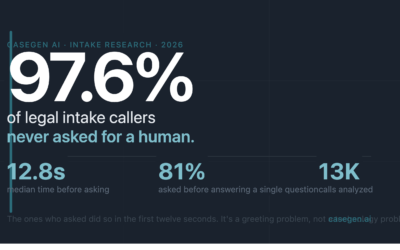
The Legal Intake Benchmark: What 13,280 Calls Reveal About Phone Greetings
Everyone says they want a human. Almost nobody asks. CaseGen AI's platform processes legal intake calls across dozens of U.S. law firms. Across 13,280 calls logged over a six-month period, one pattern held across every practice area: 97.6% of callers never asked for a...
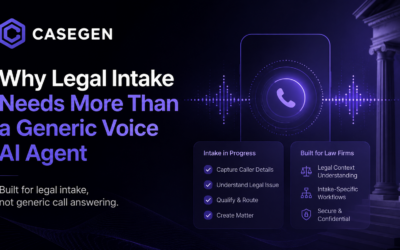
Why CaseGen’s Legal Intake is More Than a Generic Voice Agent
Summary: CaseGen AI is a legal intake voice platform built exclusively for law firms. CaseGen AI handles inbound calls, structures intake data, and connects to firm workflows so no new matter goes untracked. Most voice AI demos focus on the first thirty seconds. Does...
Why Voice AI is Replacing Traditional Legal Intake Software in 2026
The Legal Intake Revolution Has Already Started Law firms in 2026 operate in a client environment defined by immediacy, convenience, and trust. Prospective clients expect instant response, effortless communication, and human-like interaction the moment they reach out....