Everyone says they want a human. Almost nobody asks.
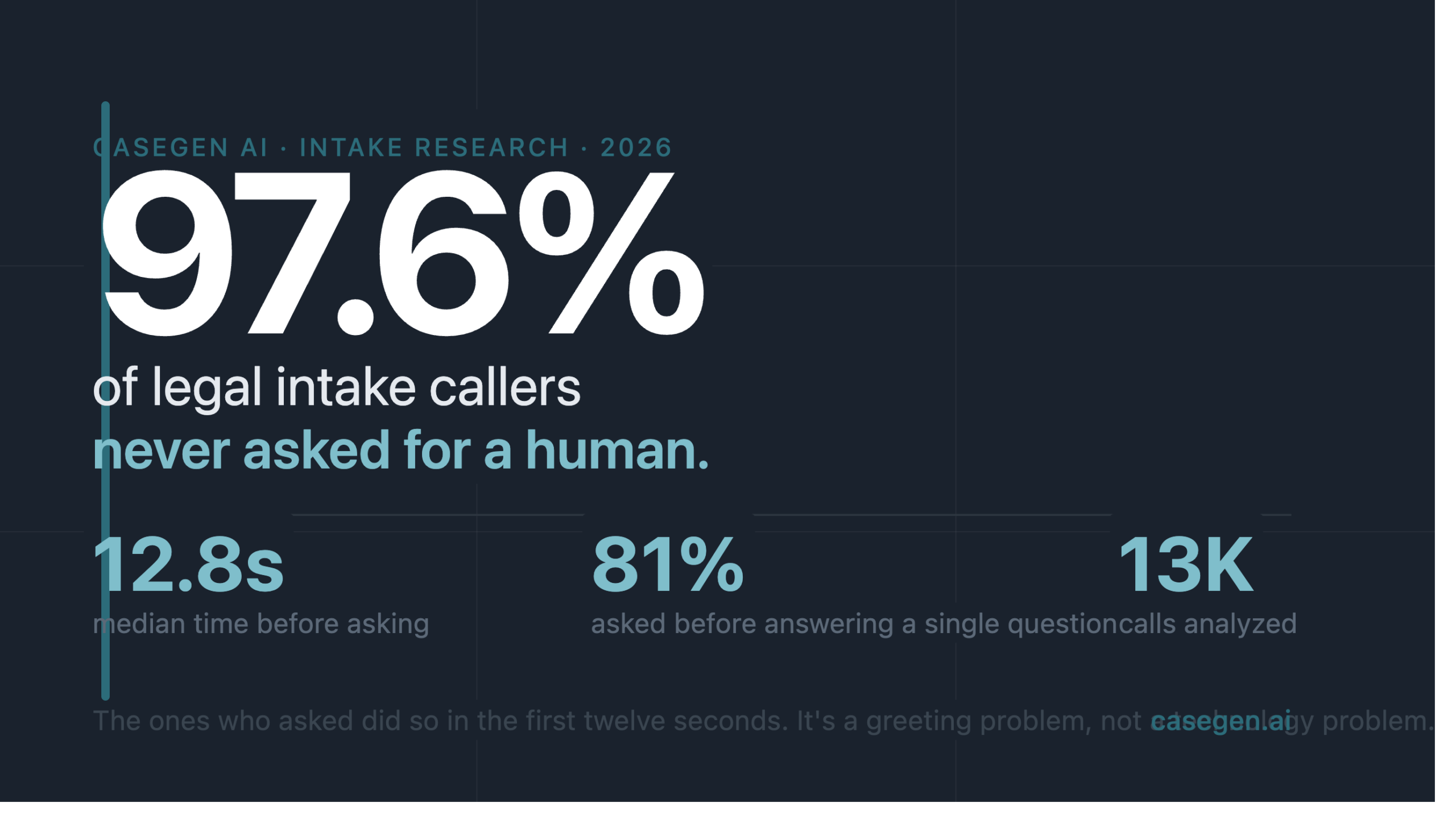
CaseGen AI’s platform processes legal intake calls across dozens of U.S. law firms. Across 13,280 calls logged over a six-month period, one pattern held across every practice area: 97.6% of callers never asked for a human. The small share who did asked within the first twelve seconds. That tells you the issue lives in the greeting, not the technology, and the fix is a design change, not a different answer to whether AI belongs at the front of your phone line.
The short answer
CaseGen AI platform data from 13,280 legal intake calls shows that 97.6% of callers never asked for a human. Of the 2.4% who did, 81% asked before answering a single intake question, at a median of 12.8 seconds. That timing matches the length of a typical law firm greeting, not the point where a conversation breaks down. Most requests for a human are a reaction to the opening seconds, and the fix is a shorter greeting plus an escalation path that works on the first request rather than the second.
What percentage of callers actually ask for a human?
In 97.6% of calls processed through our platform, the answer is zero.
CaseGen AI’s platform processes inbound legal intake calls across practice areas including personal injury, family law, criminal defense, and immigration. This report draws on platform-wide signal data from 13,280 calls logged over a six-month period in 2026. We flagged every call in which the caller asked for a person: representative, agent, operator, reception, receptionist, customer service, human, live person, real person, transfer, and related phrasings.
Now consider the surveys. Metrigy research of United States and Canadian adults found roughly 85% would prefer interacting with a human over an AI agent. SurveyMonkey put it at 79%. Kinsta put it at 93%. Those numbers get cited constantly in debates about AI phone answering, usually as evidence that adoption will fail.
The call data does not support that conclusion. Somewhere between 79% and 93% of consumers say they prefer a human in the abstract. In practice, 97.6% proceeded without asking for one. That gap is not evidence the surveys are wrong. It is evidence that stated preference and revealed behavior measure different things. On a specific call, with a specific problem, most people take the fastest available path to getting that problem in front of someone. If the first thing they encounter moves them toward that goal, they proceed. Only a small minority reaches for the escape hatch they learned twenty years ago.
Why this reframes the whole conversation about AI intake
Firms evaluating AI phone answering usually ask “will my callers reject this?” Our platform data gives a clear answer: 97.6% of callers proceeded without asking for a person. The better follow-up question is narrower still: of the small share who do ask, how many are reacting to the greeting rather than to the agent? Across our platform, four out of five. That is a design problem with a design fix, not a referendum on the technology.
Which words do callers use when they ask for a human?
The vocabulary is narrow, which is what makes it possible to catch reliably.
A caller who wants a person almost never explains themselves. They say one word, or one short phrase, and if they have to repeat it they say it the same way again rather than rephrasing. That makes the request easy to detect, provided your system is listening for the full vocabulary rather than a partial list.
These are the phrases we flag, grouped by what the caller is actually signaling. The distinction in the third column matters, because the two groups deserve different responses.
| Phrase | What it usually signals | Right response |
|---|---|---|
| “Representative” | Default escape word from large-company phone systems. Often reflexive rather than considered. | Recovery, then continue if the caller re-engages |
| “Agent” / “speak to an agent” | Same reflex. Appears more where the greeting used an assistant label. | Recovery, then continue if the caller re-engages |
| “Operator” | Older phrasing that predates modern phone menus. Skews toward callers with a durable preference for people. | Transfer or callback, do not try to recover |
| “Transfer me” / “can you transfer me” | A routing request, not a rejection. The caller believes what they need is at the office. | Transfer, or an honest callback commitment |
| “Reception” / “receptionist” | Usually mirrors a job title the greeting itself supplied. Also a routing request. | Transfer, or an honest callback commitment |
| “Human” / “real person” / “live person” | The most explicit rejection phrasing. The caller has decided and is telling you so. | Transfer or callback immediately, no recovery attempt |
| “Someone” / “somebody” | Usually embedded in a longer sentence, which makes it the hardest to match reliably. | Depends on surrounding context |
| “Customer service” | Rare in legal intake. Usually a caller who misdialed or has a billing question. | Clarify the reason for the call first |
Two things follow from this list. First, most systems listen for three or four of these and miss the rest, which is a large part of why a quarter of callers in our data had to ask twice. Second, the highlighted rows are routing requests rather than rejections, and treating them as failed containment is a category error. A caller who says “can you transfer me to the office” is asking for the same thing they would ask a live receptionist.
One methodological note that materially affects the headline rate: our phrase list was deliberately narrow. Questions like “am I talking to a real person?” and anything outside a fixed command list were excluded, and ambiguous cases were dropped rather than counted.
Is this normal? What happens when a human answers the phone
Callers ask to be transferred to the office when a live receptionist picks up too. This is not an AI problem.
Here is the context that almost every discussion of AI phone answering leaves out. Callers ask to be routed elsewhere when a human answers, constantly, and the entire answering service industry is built around that fact.
Consider what a live legal answering service actually does. A trained receptionist answers in the firm’s name, greets the caller, takes down the matter, and then either transfers the call to the office or takes a message. Screening and transfers are not an edge case in that business. They are the product. Every answering service and virtual receptionist plan on the market sells call screening and call transfer as headline features, because a meaningful share of callers reach the service and immediately say some version of “can you just put me through to the office.”
Those callers are not rejecting the human who answered. They know they are talking to a person. What they are expressing is a routing preference: they believe the thing they need lives at the office rather than with whoever picked up, and they want to skip the intermediate step. That is an entirely reasonable belief and it has nothing to do with the technology on the other end of the line.
The same request, directed at an AI agent, gets read completely differently. “Transfer me to the office” said to a receptionist is normal call handling. “Transfer me to the office” said to an AI is logged as the caller rejecting AI. It is frequently the identical request.
The comparison worth making
One AI phone answering provider reporting on a production database of roughly 1.4 million calls put the share transferred to a live person at 4.0%. Live answering services do not publish equivalent figures, but the fact that transfer handling is a core billable feature of every plan on the market indicates the rate is not trivial there either. Against that backdrop, a 2.4% floor for explicit human requests in legal intake is not an alarming number. What makes it worth acting on is not the volume. It is that 81% of it lands before the conversation starts, which means most of it is preventable.
There is a practical consequence for how firms should read their own intake reports. A request to reach the office is a routing signal that deserves a routing response, which is a transfer or a callback commitment. A request phrased as “are you a real person” or “I want a human” is a different signal that deserves a different response. Collapsing both into one “escalation rate” metric hides which problem you have.
Where the calls break
Greeting patterns from the study, drawn to actual length. The vertical mark is when callers typically asked for a human.
5s
10s
15s
18s
AI or virtual assistant label
Staff unavailable / callback later
Recording disclosure
Question to the caller
On the longest greeting the mark falls inside the bar, meaning callers were interrupting. On the others it falls just after, meaning callers listened to the end and then opted out. Those are two different failures requiring two different fixes.
How long should a law firm phone greeting be?
Roughly six seconds. Here is the line-by-line accounting.
The general standards here are not controversial and they long predate AI voice agents. One survey of business phone systems found the average greeting ran 7.9 seconds, with even the longer examples staying under 13. Platform guidance across the industry converges on keeping greetings to eight seconds or less. Professional phone answering guidance recommends the same formula a good receptionist has always used: company name, your name, offer to help, kept under ten seconds. Standard IVR abandonment benchmarks treat 2% to 5% as healthy and anything approaching 10% as a design failure.
The most useful exercise a firm can run is to time its own greeting with a stopwatch and price each component. Read the third column as an honest question: is this line buying something the caller values, or something the firm values?
| Greeting component | Typical cost | Verdict |
|---|---|---|
| Firm name | 1.5 – 2.0s | Keep. This is the caller’s confirmation they dialed correctly. |
| Agent first name | 1.0 – 1.5s | Keep. A name makes the call feel answered rather than routed. |
| Short recording notice | 1.0 – 1.5s | Keep, subject to counsel. “You’re on a recorded line.” |
| Long recording notice | 3.0 – 4.0s | Trim. “This call may be recorded for quality assurance and training purposes” costs three extra seconds on every call the firm receives. |
| “AI assistant” or “virtual assistant” label | 1.5 – 2.0s | Contested. See the label section below, and obtain a jurisdiction-specific read before moving it. |
| “Our staff is unavailable right now” | 3.0 – 4.0s | Cut. The greeting opens by telling the caller they cannot have what they want. |
| “An attorney will call you back” | 3.0 – 4.0s | Move to the close, after the matter has been captured. |
| Question to the caller | 1.5 – 2.0s | Keep. This is the entire point of the call. |
Add only the keepers and the greeting lands around six seconds. Add the cuts and it lands where the greetings in this study actually sat, between nine and eighteen.
“Hi, thank you for calling {{firm name}}, you’re on a recorded line. This is {{agent name}}. How can I help you today?”
Firm name, notice, identity, floor. Nothing else.
Why have callers been trained to escape automated phone systems?
Thirty years of conditioning is doing most of the work in those twelve seconds.
The people calling law firms today have been trained since the mid-1990s on a consistent signal: an automated voice at the start of a call predicts delay, deflection, or denial. That association was learned honestly, from decades of phone trees built to reduce headcount rather than to help callers.
The evidence that this became an organized folk practice, rather than a passing irritation, is that people built tooling for it. GetHuman launched in the mid-2000s as a crowdsourced database of escape codes for major companies, and its founder was citing an average of 38 minutes to navigate a phone system and reach a live representative. Contributors circulated tactics like pressing zero at every prompt and ignoring the synthetic voice entirely. Research on caller experience with these systems finds people describing fear of pressing the wrong option, anger when routing fails, and a general sense of being managed rather than served.
Three consequences follow, and they explain the shape of our data better than any theory about voice quality.
The trigger is the format, not the words
What sets off the learned response is not the content of a greeting. It is the shape: a smooth, evenly paced, obviously scripted voice speaking at the moment the line connects. That cue registers before comprehension does. This is why greeting wording varied enormously across accounts in our study while the timing of the request barely moved. If callers were evaluating the words, phrasing would drive the outcome. Length drives it instead.
Repeated requests are ritual, not reasoning
When a caller asks for a human and nothing happens, most do not rephrase. They repeat the same word at the same cadence. That is the behavior of someone executing a learned routine whose historical payoff was persistence, not someone updating a theory about what the system can understand. And if the system cannot be interrupted, the silence confirms the caller’s assumption: this is a recording, and recordings do not listen. Everything after that point is the caller waiting for it to end.
Disclaimer language is a classification cue
Phrases like “this call may be recorded for quality assurance and training purposes” and “our staff is currently unavailable” are not neutral information. They are the native register of institutional deflection, and callers recognize the register instantly. A small firm with a receptionist at the front desk has never said either sentence out loud. Including them does not just cost seconds. It supplies the exact signal that tells the caller which category of phone system they have reached.
Why this hurts law firms more than other industries
When someone calls a utility or a bank, they have to get through. There is no second cable company, so the caller endures the phone tree and the business records the cost as frustration. A prospective client calling a law firm has four other firms in the same search results and no relationship with any of them. In most industries, poor automated phone design produces annoyance. In legal intake it produces abandonment, on a click the firm already paid for.
Are older callers more likely to ask for a human?
Yes, substantially, and the gradient is steep enough to change how firms in some practice areas should think about escalation.
Some callers are not reacting to your greeting at all. They have a settled, durable preference for talking to a person, they have held it for decades, and no amount of greeting optimization will change it. That population is real, it is measurable, and it skews heavily by age.
When consumers are asked whether they would prefer an AI or a human agent assuming equivalent speed and service quality, the age gradient is stark: roughly 14% of Gen Z and 11% of Millennials chose AI, against 7% of Gen X and 4% of Boomers. Consumers over 55 have been reported to prefer human agents by roughly a three to one margin, while under-35 consumers show near-indifference to which they get. Employment status tracks the same pattern, with nearly 40% of retirees rejecting automation in favor of speaking to a person, the highest of any group surveyed.
For law firms this is not an abstract demographic note. It maps directly onto practice area and case mix:
- Estate planning, probate, elder law, and Social Security disability serve caller populations weighted toward the segment with the strongest human preference. These firms should expect a materially higher rate of human requests than the 2.4% aggregate and should build a real escalation path rather than optimizing it away.
- Personal injury and criminal defense skew younger and more urgent, and urgency tends to override preference. A caller who needs help tonight will take help from whoever answers.
- Immigration and multilingual intake fail differently and should be measured separately. Limited-English callers who ask for a person are frequently signaling a language handling problem rather than a preference for humans, and mixing them into an aggregate escalation rate obscures both.
There is one more finding worth holding alongside the preference data. In one consumer survey, 84% of callers said their biggest frustration with phone service was wait time, not whether the agent was human or AI. Preference for a person is real, but it is not the top-ranked concern in the moment. Speed usually wins, which is precisely why a six-second greeting outperforms an eighteen-second one regardless of who or what is speaking.
The design implication
Do not try to talk the old-school caller out of their preference. It is a settled position held for good historical reasons, and fighting it on the phone converts a routine request into a bad experience. Honor it on the first ask, immediately, and treat the transfer or callback as a successful outcome rather than a failed containment. The callers you can win back with better design are the ones reacting to the greeting, and they are four out of five of the total.
The number with no excuse: 27.5% had to ask twice
Whatever the caller wanted, asking again means the request was not registered.
Of 269 callers in our study who asked for a human, 74 were not answered on the first request. A meaningful number asked three times, at near-identical intervals, which is the signature of a request that was never being detected rather than one being declined.
This finding needs no denominator and no interpretation. Reasonable people can disagree about whether a caller should have wanted a human. Nobody disagrees that a caller asked, nothing happened, and they asked again.
Published benchmarks for AI voice deployments generally target a total escalation rate under about 15%, and they draw a sharp line between escalation categories. Escalations where the agent could not identify the caller’s intent indicate knowledge gaps. Escalations where the caller explicitly asked for a person indicate conversation design problems. In this study the requests were almost entirely the second kind, and 81% of them arrived before the agent had any opportunity to demonstrate competence.
The escalation standard we recommend
First request, honored immediately. Any of: representative, agent, operator, reception, receptionist, customer service, human, live person, real person, somebody, someone, transfer. The first match stops the current intake question and moves the agent into recovery. The recovery response is capped at one short sentence, because a six second recovery gets interrupted for the same reason the greeting did.
Second request, hard stop. Abandon the intake. Capture the name and callback number, close politely. The target is zero third requests. A captured callback beats a caller repeating themselves at an automated system every time.
Interruption enabled on the first message. If barge-in is disabled on the greeting, a caller speaking at eight seconds is not being ignored. They are inaudible. Interruptibility is the single strongest signal that a caller has reached a conversation rather than a recording.
Does what you call the AI change what callers ask for?
A strong hypothesis from our data, not a settled finding.
Across the accounts in this study, the specific words callers used to ask for a human tracked the specific words the greeting used to describe the assistant. Greetings that used a job title tended to draw requests for the human version of that same title. A greeting that introduced the assistant as a receptionist drew requests for reception, a phrasing that barely appeared anywhere else in the dataset. The accounts using no label at all showed mixed phrasing and the lowest rate of repeated requests.
There is a plausible mechanism. Labels like “virtual assistant” and “AI receptionist” rarely tell callers anything they had not already assumed by the second. What they do is assign a tier. The caller hears the noun, retrieves a schema built from decades of automated phone systems, and with it the belief that a higher tier exists and must be requested by name.
The honest caveat: a handful of greeting configurations is a handful of data points that happen to line up. This is exactly the kind of pattern that looks obvious and turns out to be confounded by practice area, lead source, or caller demographics. Any firm with call data can test it directly by comparing greeting text against escalation phrasing across their own call history.
None of this is an argument for concealing what the assistant is. There is a real difference between leading with a job title and hiding one. An intake agent that confirms it is an AI the moment anyone asks is being honest. An intake agent that opens with a job title is priming the caller to sort the interaction into a category before they have heard anything useful.
Never offer a human you cannot produce
The worst greeting pattern in the study was not the longest one.
One recurring pattern involved a greeting that mentioned staff being available if needed, then asked the caller what they needed. Callers politely accepted the offer and asked for reception. That is not someone fleeing an automated system. That is someone taking a business up on something it just said.
The failure was what happened next, which in several calls was nothing at all. Promising a live human and not producing one is worse than never offering, because it converts a neutral interaction into a broken one at the exact moment the caller was cooperating.
Before any escalation copy is written, the firm has to answer a plain operational question: is there a person who can take a live transfer during business hours, yes or no? If yes, build the transfer. If no, the sentence comes out of the greeting today, because the system is currently telling every caller something that is not true.
How should an after-hours law firm greeting differ?
The most common mistake is treating the night shift as the day shift with an apology attached.
Roughly 30% to 45% of new client inquiries at law firms arrive after 5pm or on weekends, and firms without an answering solution miss effectively all of them. Legal emergencies are not evenly distributed across the business day. Arrests, accidents, and domestic incidents skew heavily toward evenings and weekends, and weekend personal injury inquiries have been reported to involve more serious injuries and higher potential case values than the weekday average. The hours a firm covers least well are often the hours worth the most.
Here is the counterintuitive part. Most firms make the after-hours greeting longer than the business-hours greeting, because it feels like the moment to explain the situation. That is backwards. At 11pm the caller already knows nobody is at the front desk. Explaining it costs four seconds and tells them nothing they did not know when they dialed.
What actually changes after hours
The opening stays the same length. Around six seconds, same structure. What the caller is testing in those seconds is identical to daytime: did a competent entity answer this phone.
The close carries the weight instead. Everything tempting to put in an after-hours greeting belongs at the end of the call, after the name, number, and matter have been captured. By then the firm has earned a few seconds of expectation setting.
State a specific callback window. This is the most consistent piece of guidance across after-hours standards. “Within 24 hours,” “first thing Monday morning,” or “before end of business tomorrow” all work. “As soon as possible” reads as an empty promise to an anxious person, and it is heard as one.
Provide an urgency path. If a caller has a hearing in the morning or a family member in custody right now, the intake needs somewhere to put that. A single branch is enough. Without one, the most urgent caller of the night receives the same handling as a billing question.
Add a confidentiality note where it matters. For criminal defense and family law in particular, a brief line asking callers not to share sensitive case detail protects everyone. Place it at the close, not the open.
Do not imply a transfer that does not exist at 2am. If nobody is reachable overnight, the escalation path is a captured callback with a stated window, and the agent should say exactly that. This matters more after hours than during the day, because the caller asking to be put through to the office at midnight is asking for something that does not exist, and the honest answer serves them better than a vague one.
“Hi, thank you for calling {{firm name}}, you’re on a recorded line. This is {{agent name}}. How can I help you tonight?”
Then, at the close, once the matter has been captured:
“I’ve got everything I need. Someone from the firm will call you back before noon tomorrow at this number. If anything changes before then, call us back anytime.”
Segment intake metrics by time window
A 2am call and a 2pm call are different products with different caller intent, different urgency, and different competitive dynamics. Averaging them hides both. Any firm reviewing intake performance on a single blended number is looking at the wrong number.
What are the disclosure requirements for AI phone answering?
Orientation only. This is not legal advice, and every firm needs a current jurisdiction-specific read.
Call recording notice
Federal law is one-party consent. Roughly a dozen states require all-party consent, including California, Florida, Illinois, and Washington. Because calls cross state lines constantly and the caller’s location is rarely known at answer time, notice on every call is the conservative default.
The question is not whether to give notice. It is how many words it takes. “You’re on a recorded line” and “this call may be recorded for quality assurance and training purposes” convey the same fact, and one costs three extra seconds on every call a firm receives. Whether the shorter form satisfies notice requirements in a given jurisdiction is a question for counsel, but it is worth actually asking rather than assuming.
AI disclosure
This area is a genuine patchwork and it is moving quickly enough that anything written today needs rechecking. The landscape currently includes California’s B.O.T. Act, which prohibits using a bot to deceive someone about its artificial identity in a commercial context; Utah’s AI Policy Act, which requires disclosure on request and proactive disclosure for regulated occupations; a Texas provision requiring AI voice disclosure within the first thirty seconds of a call; and a pending FCC rulemaking on AI-generated voice. Colorado’s AI Act has been amended and its scope and effective date have shifted, and published summaries of it conflict, which illustrates why this needs a current read from counsel rather than a blog post.
Note what these requirements generally do and do not say. Several require honesty on request. Several require disclosure within a window, commonly thirty seconds, rather than in the opening sentence. There is often real distance between “must disclose” and “must lead with it,” and that distance is worth several seconds of caller attention.
For law firms there is an additional layer that generic guidance misses. An AI answering a firm’s phone is communicating with a prospective client, which brings state bar advertising and communication rules into scope. Ethics counsel should be involved, not only privacy counsel.
What this study cannot tell you
Stated plainly, so the numbers are not over-read.
- The 2.4% is a floor. The phrase list was narrow and ambiguous cases were excluded, so the true rate of callers wanting a person is higher than what we measured.
- No outcomes. The source data does not indicate whether these calls converted, transferred, or ended. This measures a symptom and infers a cost.
- No per-account denominators. Total call volume by account was not available for the same window, so cross-account rate comparisons are provisional. The aggregate figures are the reliable ones.
- Silent hangups are invisible. Callers who simply stopped talking and left do not appear in this dataset at all. If hangup timestamps cluster around the 30 second mark, the mid-conversation problem is larger than it appears here.
- No caller demographics. The age findings cited here come from published consumer surveys, not from our call data. We cannot confirm that older callers in our dataset asked for humans at higher rates, only that surveyed consumers report a strong age gradient in preference.
- Conditioning is the best available explanation, not a proven one. The timing clusters are consistent with learned escape behavior. They are also consistent with simple boredom. The practical recommendations are identical either way.
Audit your own greeting this week
- Call your own main number with a stopwatch. Business hours first, then again at 7pm on a Friday. Time from the moment the line connects to the moment you are asked a question. Write the number down.
- Interrupt it. Say “representative” four seconds in. If nothing happens, interruption is disabled on your first message and every impatient caller is speaking into a void.
- Ask twice. Ask for a human, wait, ask again. Count how many attempts it takes before something changes. More than one is your highest-value fix.
- Separate routing requests from rejection. Review a sample of escalations and sort them: “transfer me to the office” is a routing preference, “are you a real person” is something else. They need different responses.
- Test every promise. If the greeting mentions staff, an attorney, or a callback, verify that the promised thing actually happens. Then verify it at 8pm.
- Read the greeting aloud and cross out every clause that serves the firm rather than the caller. Quality assurance language, availability disclaimers, and hold apologies are the usual suspects.
- Get counsel’s read on the short recording notice and on AI disclosure timing in every state the firm takes calls from.
- Split intake metrics into business hours and after hours before drawing any conclusion from them.
Frequently asked questions
What percentage of callers ask to speak to a human?
CaseGen AI platform data from 13,280 legal intake calls shows that 97.6% of callers never asked for a human at all. Of the 2.4% who did, roughly 1.9% of all calls had the caller asking before answering any intake question, and about 0.3% asked mid-conversation. Consumer surveys consistently find that 79% to 93% of people say they prefer human agents in the abstract, but call behavior shows the large majority proceed without asking for one.
Do callers ask to be transferred even when a human answering service picks up?
Yes. Requests to be transferred directly to the office are a normal part of live answering service operations, which is why every answering service plan on the market sells call screening and transfer as a core feature. A caller asking to reach the office is not rejecting the person who answered, they are stating a routing preference. The same request directed at an AI agent is often misread as rejection of the technology.
How long should a law firm phone greeting be?
About six seconds, containing four elements: the firm name, a recording notice, the name of whoever is answering, and an open question. Business phone system surveys put the average greeting across industries at 7.9 seconds, and platform guidance generally recommends eight seconds or less.
Why do callers ask for a human before answering any questions?
Most callers who ask for a human are responding to the greeting rather than to the conversation. Across CaseGen AI’s platform data, 81% of requests came in the first turn, clustered between 8 and 16 seconds. That timing matches greeting length rather than the point at which a conversation could realistically break down.
Are older callers more likely to ask for a human?
Survey data shows a strong age gradient in stated preference. Asked whether they would prefer AI or a human agent at equivalent speed and quality, roughly 14% of Gen Z and 11% of Millennials chose AI, against 7% of Gen X and 4% of Boomers. Consumers over 55 have been reported to prefer humans by roughly three to one, and nearly 40% of retirees reject automation in favor of a person. Practice areas serving older clients should expect higher escalation rates and build a real transfer path.
What is a good escalation rate for an AI voice agent?
Published benchmarks generally target a total escalation rate under about 15%. The category matters more than the number: escalations caused by unrecognized intent indicate knowledge gaps, while escalations where the caller explicitly asked for a person indicate conversation design problems, most often a greeting that is too long or cannot be interrupted.
Should the after-hours greeting explain that the office is closed?
No. At 11pm the caller already knows the office is closed, so explaining it spends attention on information they already have. Keep the after-hours opening the same length as the business-hours opening and move expectation setting, including a specific callback window, to the close of the call.
The thing worth remembering
Firms spend heavily on the click. The ad, the keyword, the landing page, the tracking number. Then the phone rings and a stretch of unexamined boilerplate decides whether any of that spend converts.
Almost nobody asks for a human. The people who do fall into two groups: a small, durable population who have preferred people for thirty years and will not be argued out of it, and a much larger group reacting to twelve seconds of preamble that nobody at the firm has ever timed. The first group deserves a fast, gracious transfer. The second group never needed to ask.
Six seconds. Firm name, recording notice, a name, a question. Then get out of the way and let them talk.
Explore the Intake Workflow
For the operational steps around the first conversation, see CaseGen’s AI legal intake software guide and phone follow-up for incomplete intake. These product workflows are separate from the findings and limitations of this report.