


Backed by MAF Legal
Every law firm has the same problem: the phone rings constantly, qualified leads get missed after hours, and your legal secretary spends more time answering the same intake questions than doing the work that actually moves cases forward. An AI legal secretary solves all three, and it does it without adding headcount.
This guide explains exactly what an AI legal secretary is, what it can and cannot do, how it compares to your in-house team, and how CaseGen’s AI agents, Justina, Justin, and Maya, work together to handle the full communication load of a modern law firm.
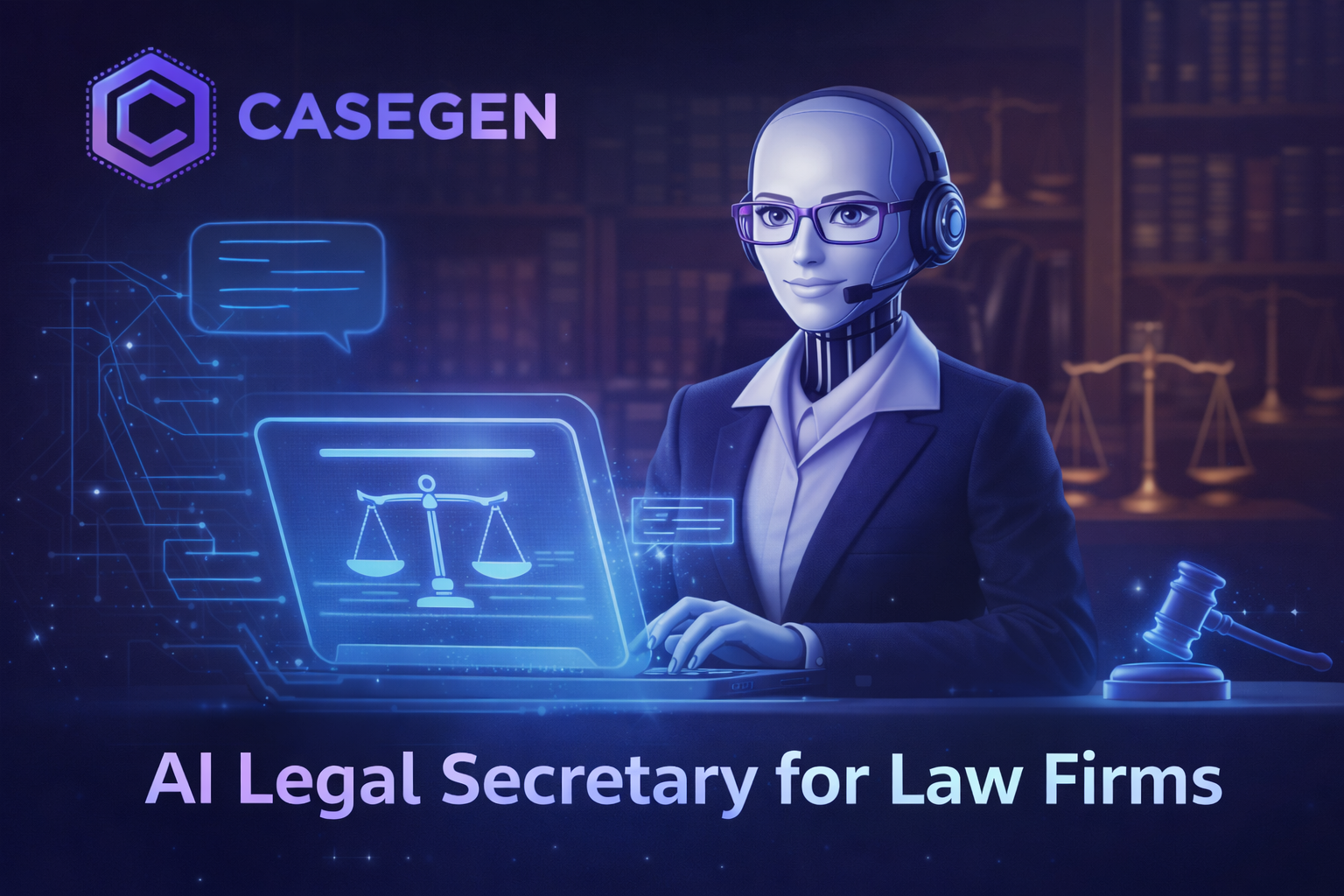
What is an AI legal secretary?
An AI legal secretary is a voice-enabled AI agent trained to perform the communication and administrative functions of a traditional legal secretary — without requiring human staff involvement. It answers inbound calls, qualifies new client inquiries, gathers intake information, schedules consultations, and routes calls to the right person, around the clock, every day of the year.
Unlike a general virtual receptionist service or an off-the-shelf AI chatbot, a purpose-built AI legal secretary understands law firm workflows. It knows the difference between a personal injury intake and a criminal defense intake.
It knows when to ask about the date of incident and when to ask about the statute of limitations. It knows how to handle a distressed caller with empathy, and it knows when a call needs to be transferred to a live attorney immediately.
CaseGen’s AI legal secretary Justina is built exclusively for law firms. She is not a generic AI assistant repurposed for legal use. Every element of her call logic, her question sequencing, her transfer behavior, and her voice persona has been engineered specifically for law firm intake environments.
Key capabilities of an AI legal secretary
- Answer every inbound call — no voicemail, no missed leads
- Conduct structured new client intake across any practice area
- Qualify or disqualify leads based on your firm’s criteria
- Schedule consultations and sync with attorney calendars
- Perform warm or cold transfers to staff or attorneys
- Handle after-hours, weekend, and holiday call volume
- Operate in English and Spanish
- Log every call, transcript, and intake detail automatically
How can an AI legal secretary help my law firm?
The average law firm misses between 35% and 50% of inbound calls. Of those missed calls, the majority never call back, they move on to the next firm that picks up. That is not a staffing problem. It is a revenue problem. An AI legal secretary eliminates it entirely. Here is what changes when Justina is handling your inbound calls:
Every call gets answered, every time
Justina picks up on the first ring at 2 p.m. on a Tuesday and at 11 p.m. on a Saturday. There are no hold queues, no voicemails that sit until Monday morning, and no “we’re closed” messages that send a qualified lead to your competitor. Every caller gets a responsive, professional experience regardless of when they call.
Intake quality becomes consistent
Human intake quality varies. A busy morning means rushed calls. A distracted staff member means missed questions. Justina asks the same intake questions the same way on every single call, ensuring your attorneys always receive complete, accurate information before a consultation. No gaps. No inconsistencies.
Leads stop falling through the cracks
When a new client calls and does not convert immediately, they need time to think, they have questions, they are comparing firms, Justina captures their information and hands it off to Justin, CaseGen’s outbound follow-up agent, who continues the conversation via call or SMS until a retainer is signed or the lead is disqualified. No lead goes cold by default.
Your staff gets their time back
A significant portion of what legal secretaries handle each day, answering the same intake questions, scheduling consultations, relaying messages — can be handled by AI with no loss in quality.
When Justina absorbs that volume, your team can focus on the work that requires human judgment: document preparation, client relationship management, court coordination, and supporting your attorneys on complex matters.
Your firm operates without capacity constraints
Staffing is finite. You can only hire so many people, and each person can only handle so many calls. Justina scales infinitely. Whether your firm receives 10 calls a day or 200, she handles every one with the same quality. There is no overflow. There is no crunch.
AI legal secretary vs. your in-house legal secretary
One of the most common questions law firms ask is whether an AI legal secretary replaces their existing staff. The short answer is no, and the longer answer explains why the two work better together than either does alone. Your in-house legal secretary is irreplaceable for the work that requires human judgment, institutional knowledge, and genuine client relationships.
What they should not be doing and what consumes a disproportionate amount of their day is answering repetitive intake calls, chasing down leads who have not returned messages, and managing scheduling logistics that an AI can handle in seconds.
What Justina handles — so your legal secretary does not have to
- All inbound intake calls — every new client inquiry, screened, qualified, and documented before it reaches your team
- After-hours and weekend calls — no more Monday morning voicemail backlogs
- Appointment scheduling — consultation booking based on attorney availability, confirmed via SMS or email
- Lead follow-up — outbound calls and messages to unconverted inquiries, handled by Justin
- Repetitive FAQ calls — office hours, parking, what to bring, case status prompts that don’t require attorney involvement
- Initial Spanish-language calls — full bilingual intake without requiring bilingual staff on duty
What your human legal secretary does better than any AI
- Manage complex, multi-step client relationships over time
- Handle emotionally sensitive conversations that require genuine empathy and nuanced judgment
- Coordinate directly with courts, opposing counsel, and external parties
- Prepare, review, and organize legal documents requiring institutional knowledge
- Support attorneys in real time during active case work
- Exercise professional discretion in ambiguous situations
The practical effect of deploying Justina is that your legal secretary becomes a higher-value team member. The intake triage, the call volume, the repetitive scheduling — all of that gets absorbed by AI. What remains is the substantive, relationship-driven work your staff was hired to do in the first place.
A direct comparison
| Function | In-House Legal Secretary | Justina — CaseGen AI |
|---|---|---|
| Availability | Business hours only | 24/7/365 including holidays |
| Inbound call capacity | One call at a time | Unlimited simultaneous calls |
| Intake consistency | Varies by day, person, and call volume | Identical quality on every call |
| After-hours coverage | Requires overtime or answering service | Included, no additional cost |
| Bilingual support | Only if staff speaks Spanish | Native English and Spanish |
| Outbound follow-up | Manual, time-consuming, often deprioritized | Automated via Justin agent |
| Document preparation | Yes — core strength | Not applicable |
| Attorney relationship support | Yes — core strength | Not applicable |
| Cost | Salary, benefits, PTO, turnover risk | Flat monthly subscription |
| Scalability | Requires hiring to scale | Scales instantly with call volume |
The most effective law firms do not choose between their legal secretary and an AI agent. They use both — with Justina handling the volume and their human team handling the work that matters most.
CaseGen AI features: what Justina, Justin, and Maya actually do
CaseGen is not a single AI tool it is a team of three purpose-built agents, each responsible for a different part of the client lifecycle. Together, they cover the full journey from first phone call to signed retainer to ongoing case coordination.
Justina inbound intake and call management
Justina is your AI legal secretary. She is the voice of your firm for every inbound call — new clients, existing clients with questions, Spanish-speaking callers, after-hours inquiries, and high-volume periods when your staff cannot keep up.
What Justina does on every call
- Answers immediately — no hold time, no voicemail, no “please press 1”
- Identifies the caller’s need — new client inquiry, existing client update, general question, or emergency
- Conducts structured intake — asks the right questions for your specific practice areas, in the right sequence, without redundancy
- Qualifies or disqualifies the lead — based on your firm’s case acceptance criteria
- Schedules the consultation — books directly based on attorney availability and confirms the appointment with the caller
- Performs call transfers — warm or cold, to the right staff member or attorney, with clear communication to the caller throughout the handoff
- Logs everything — full transcript, caller information, intake data, and outcome are captured automatically
Justina’s call intelligence
Justina is not reading from a fixed script. She is trained on law firm intake logic and uses dynamic conversation flow — meaning she adapts based on what the caller says. If a caller volunteers that they were injured six months ago, Justina does not ask them again when the incident occurred.
If a caller indicates they are calling about a criminal matter rather than a civil one, she routes to the right intake flow automatically. This is the difference between a voice bot and a voice agent.
24/7 intake and after-hours call coverage
Legal emergencies do not happen between nine and five. A car accident victim calls at midnight. A potential criminal client calls on a Sunday. A Spanish-speaking caller who works during the day can only call in the evening.
Every one of these callers is a potential client and without 24/7 coverage, every one of them is a missed opportunity. Justina answers every call, at any hour, with the same quality and professionalism as a daytime call handled by your best staff member.
She collects intake information, schedules the consultation, and ensures your attorneys walk in on Monday morning with a full, qualified pipeline not a voicemail backlog.
Bilingual English and Spanish support
For immigration law firms, personal injury firms, criminal defense practices, and any firm serving diverse communities, the ability to conduct a full, professional intake in Spanish is not optional it is a competitive necessity. Most virtual receptionist services cannot do it well.
Most AI tools cannot do it at all. Justina conducts complete, native-quality intake conversations in both English and Spanish. She handles the full call not just a greeting and switches languages naturally based on the caller’s preference.
She is also configured with accurate pronunciation of your attorneys’ and staff members’ names in both languages, which matters more than most firms realize when a Spanish-speaking client is trying to understand who they are being transferred to.
Justin outbound follow-up and retainer conversion
Justina captures the lead. Justin closes it. Justin is CaseGen’s outbound AI agent, responsible for following up on every unconverted inquiry — callers who expressed interest but did not book a consultation, leads who requested a callback, and cases where additional information is needed before a consultation can be scheduled.
What Justin does
- Outbound follow-up calls — reaches out to unclosed leads on a defined schedule so no potential client is forgotten
- SMS follow-up sequences — sends branded, firm-specific messages that re-engage leads who did not convert on first contact
- Retainer conversion support — reminds prospects of their consultation, answers pre-consultation questions, and moves them toward a signed agreement
- Lead reactivation — re-engages older inquiries that went cold before a decision was made
The majority of signed retainers in a law firm do not come from the first call they come from consistent follow-up. Justin systematizes that follow-up so it happens on every lead, every time, without relying on staff to remember or prioritize it.
Maya medical coordination for personal injury firms
Personal injury law firms have a layer of case administration that goes beyond intake and follow-up: coordinating medical treatment for injured clients, tracking treatment progress, following up with providers, and ensuring clients are moving through the medical process that supports their legal case. Maya is CaseGen’s medical coordination agent, built specifically for this need.
What Maya does
- Medical appointment coordination — helps clients schedule and follow through on treatment with medical providers relevant to their case
- Treatment progress check-ins — reaches out to clients to confirm they are attending appointments and following prescribed treatment
- Provider communication support — facilitates information flow between your firm and treating physicians or clinics
- Case file updates — logs medical coordination activity so your attorneys and paralegals always have a current picture of each client’s treatment status
For personal injury firms, Maya is the difference between cases that move efficiently and cases that stall because medical coordination fell through the cracks.
How CaseGen deploys your AI legal secretary
CaseGen is not a self-service platform where you set up a chatbot and hope for the best. Every deployment is built specifically for your firm’s practice areas, intake criteria, transfer logic, and brand voice. Here is how it works:
Step 1 — Discovery and intake mapping
CaseGen works with your team to document exactly how your intake process works: which case types you accept, what questions Justina should ask for each, what answers disqualify a lead, and who calls get transferred to in each scenario. This becomes the foundation of Justina’s call logic.
Step 2 — Agent configuration and prompt engineering
Justina’s voice, tone, conversation flow, and decision logic are configured to match your firm’s identity and intake requirements. Bilingual settings, staff name pronunciations, practice-area-specific question sequences, and transfer rules are all built and tested in this phase.
Step 3 — Phone system integration
Justina connects to your existing phone system. Calls can be forwarded to her number, or she can serve as your primary inbound line. No hardware changes, no complex IT setup.
Step 4 — Testing and quality assurance
Before going live, CaseGen runs structured test calls to validate intake logic, transfer behavior, speech recognition accuracy for legal terminology and proper nouns, and edge case handling. Any issues are resolved before a real client hears Justina’s voice.
Step 5 — Go live and ongoing optimization
Justina goes live and begins handling real calls. CaseGen monitors transcripts, flags performance issues, and continuously refines the agent based on real-world call data. Your AI legal secretary improves over time — not just on day one.
Ready to see your AI legal secretary in action?
CaseGen is deployed at law firms across the country personal injury practices, immigration firms, criminal defense attorneys, and multi-practice regional firms — all using Justina, Justin, and Maya to handle the communication work that used to fall on their staff.
If your firm is missing calls after hours, losing leads to slow follow-up, or watching your legal secretary spend her best hours on intake logistics instead of substantive work, an AI legal secretary is the most direct solution available today.
Book a live demo at casegen.ai and hear Justina in action on a real intake call.
Industry
Client Testimonials


Recent Posts
Frequently asked questions about AI legal secretaries
What is an AI legal secretary?
An AI legal secretary is a voice and messaging AI agent that handles the communication and administrative functions of a traditional legal secretary answering inbound calls, qualifying new client inquiries, scheduling consultations, following up with leads, and coordinating case-related tasks without requiring human staff involvement.
CaseGen’s AI legal secretary, Justina, is trained exclusively for law firm environments and operates 24 hours a day, 7 days a week, including weekends and holidays.
How can an AI legal secretary help my law firm?
An AI legal secretary ensures every inbound call is answered and qualified, every new lead is followed up on, and every intake is documented even after hours, on weekends, and during peak call volume.
CaseGen’s AI agents reduce missed leads, capture more signed retainers, and free your in-house team to focus on complex client work and billable tasks rather than repetitive phone management.
Is an AI legal secretary a replacement for my human legal secretary?
No. Justina is designed to handle high-volume, repetitive communication work answering calls, screening inquiries, scheduling, sending follow-up messages — which can consume 60% or more of a legal secretary’s day.
This frees your human team for the relationship-driven, judgment-intensive work that requires real expertise. Justina handles the volume; your legal secretary handles the nuance. The two work as a team.
Does CaseGen's AI legal secretary support Spanish-speaking clients?
Yes. Justina supports fully bilingual English and Spanish conversations, including accurate pronunciation of attorney and staff names and correct use of legal terminology in both languages. This is particularly valuable for immigration, personal injury, and criminal defense firms serving Spanish-speaking communities.
What happens when a call needs to be transferred to an attorney or human staff member?
Justina is configured with intelligent transfer logic specific to your firm. When a call requires attorney judgment, involves an emergency, or falls outside defined intake parameters, she performs a warm or cold transfer to the appropriate team member and communicates clearly with the caller throughout the handoff.
What AI agents does CaseGen offer beyond the legal secretary function?
CaseGen offers three purpose-built AI agents: Justina (inbound intake and client qualification), Justin (outbound lead follow-up and retainer conversion), and Maya (medical record and treatment coordination for personal injury practices).
Together they form a complete AI legal staff pipeline covering the full case lifecycle from first contact to signed retainer.
How is CaseGen different from general AI assistants or virtual receptionist services?
CaseGen is built exclusively for law firms. Unlike general AI tools, Justina understands legal intake logic, case type qualification, attorney scheduling requirements, statute of limitations urgency, and legal confidentiality norms.
Unlike traditional virtual receptionist services, CaseGen agents operate in real time with no hold queues, no shift gaps, and no per-minute billing.
Schedule Your Free CaseGen Demo Today
One Lawyer. One Legal Growth Expert.